

Two Kinds of Overwhelm, and Why They Need Different Things
Have you ever tried a grounding technique, the kind you've read about or been taught, and it simply did not seem to work? Or has there been a period when you looked and sounded fine on the outside, while internally feeling strangely far away from everything, including yourself?
These are opposite problems that require different coping techniques. There's actually a framework for this, it's called the window of tolerance. Understanding the window of tolerance and which side of it you are on will point you toward the grounding techniques that actually help.
This article is a companion to an earlier one on grounding techniques. That piece covered the how. This one covers the why.
There isn't one "overwhelmed," there are two
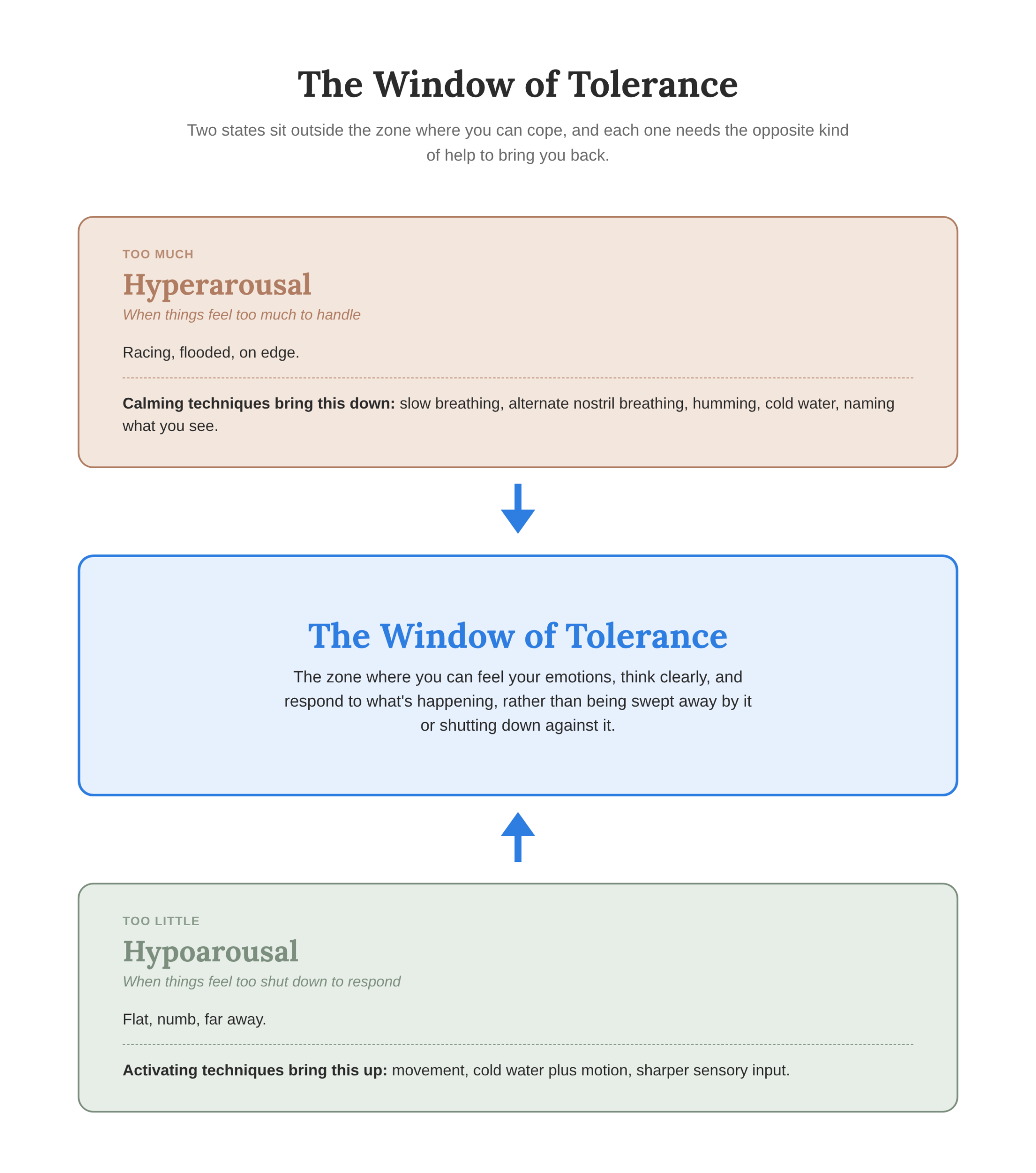
Psychiatrist Dan Siegel described something called the window of tolerance, the zone of arousal where you can feel your emotions, think clearly, and respond to what's happening around you, rather than being swept away by it or shutting down against it (Siegel, 1999).
Outside that window, you don't just become "more stressed." You tip into one of two distinct states.
One is hyperarousal. "My heart won't stop racing, and I don't know why I'm this on edge over something so small." Your system floods, and you become reactive, hypervigilant, flooded with sensations. Everything feels overwhelming and urgent.
The other is hypoarousal. "I don't feel anxious. I just feel... nothing." Your system does the opposite, and you go flat, numb, disconnected, sometimes to the point of feeling empty or unreal (Corrigan, Fisher, & Nutt, 2011).
One is too much. The other is too little. Both sit outside the window where you can actually cope, and they call for opposite responses.
Why the same grounding technique can fail, or even backfire
"I tried the breathing thing. It didn't do anything."
Here's the part that usually gets left out of grounding advice. Most popular grounding techniques, slow breathing, cooling your face with cold water, naming things you can see around you, are built to bring hyperarousal down into the window. They work by calming an overactivated system.
If you're already in hypoarousal, already underactivated, already flat, a calming technique doesn't bring you up into the window. It can push you further down, deeper into the numbness you were trying to get out of. This is very likely why so many people try a grounding technique, find it does nothing, or find it makes them feel worse, and quietly conclude that grounding "doesn't work for them." It was not the wrong idea. Perhaps it was the wrong direction for the state they were actually in.
Why hypoarousal is the one that hides, especially here
Hyperarousal tends to get noticed, by you and by the people around you, because it looks like distress. Hypoarousal usually doesn't get noticed because a flat, numbed-out, going-through-the-motions state can look a lot like composure from the outside. Sometimes it even gets praised as composure.
"You're handling this so well."
In Singapore specifically, a culture that tends to reward pushing through and keeping things together, this blind spot runs deeper. A 2024 workplace survey by Employment Hero found 61% of Singapore workers reporting burnout, barely moved from 62% two years earlier, suggesting burnout has become the norm for a lot of people rather than a passing phase. Underneath a number like that, a lot of what gets called "coping well" may actually be hypoarousal wearing a calm face, not because the person is fine, but because their nervous system has learnt to quietly power down rather than light up.
What genuinely tends to help
"Am I speeding up right now, or slowing down?"
That single question is the first useful move, and it tells you which direction you actually need to move.
If you're speeding up, flooded, racing, keyed up, the aim is to bring your system down. Slow, longer exhales than inhales. Alternate nostril breathing. Humming, which stimulates the vagus nerve through the vibration in your throat. Cold water on your face or wrists. Naming five things you can see, slowly, one at a time. These work by calming an overactivated nervous system, which is the state they were designed for.
If you're slowing down, flat, foggy, far away, the aim is to bring your system back up into the window, not further down. In this hypoaroused state, movement helps more than stillness does. Standing up, stretching, pressing your hands firmly against a wall, splashing cold water and then moving your body right after. Sharper sensory input, a strong scent, a piece of music, bright light, can help pull you back into the present rather than deeper away from it.
And if any of these techniques feels effortful, harder than it looks like it should be for other people, that doesn't mean you're doing it wrong or that the technique is not working. The struggle is mostly about how burdensome it feels in the moment, especially if it is something that you are not used to. Recent research tracking people's daily emotion regulation found that people who find distress harder to tolerate report more effort and more difficulty, but are not actually less successful at regulating their emotions than anyone else (Gross, Eckland, & Thompson, 2026).
Closing
Grounding techniques are not one-size-fits-all. Knowing which direction your system actually needs, up toward the window or down into it, is often the missing piece that makes the techniques you already know finally make sense. You are not bad at coping. You may just have been reaching for the right tool pointed the wrong way.
Not sure which state you tend to go to?
A therapist can help you recognise your own patterns and build a toolkit that actually fits them. Send us a message and we will help you find the right support.
If you are having thoughts of harming yourself or ending your life, please know that you do not have to face this alone. Reach out to one of the following 24-hour crisis lines.
1767 — Samaritans of Singapore (SOS)
6389 2222 — Institute of Mental Health (IMH)
- 1 Corrigan, F. M., Fisher, J. J., & Nutt, D. J. (2011). Autonomic dysregulation and the window of tolerance model of the effects of complex emotional trauma. Journal of Psychopharmacology, 25(1), 17–25.
- 2 Employment Hero. (2024). Wellness at Work report.
- 3 Gross, A. M., Eckland, N. S., & Thompson, R. J. (2026). Distress intolerance is associated with emotion regulation effort and difficulty, but not success in daily life. Behavior Therapy, 57(3), 481–492.
- 4 Siegel, D. J. (1999). The developing mind: Toward a neurobiology of interpersonal experience. Guilford Press.
- 5 Feature image: Rohit / Unsplash